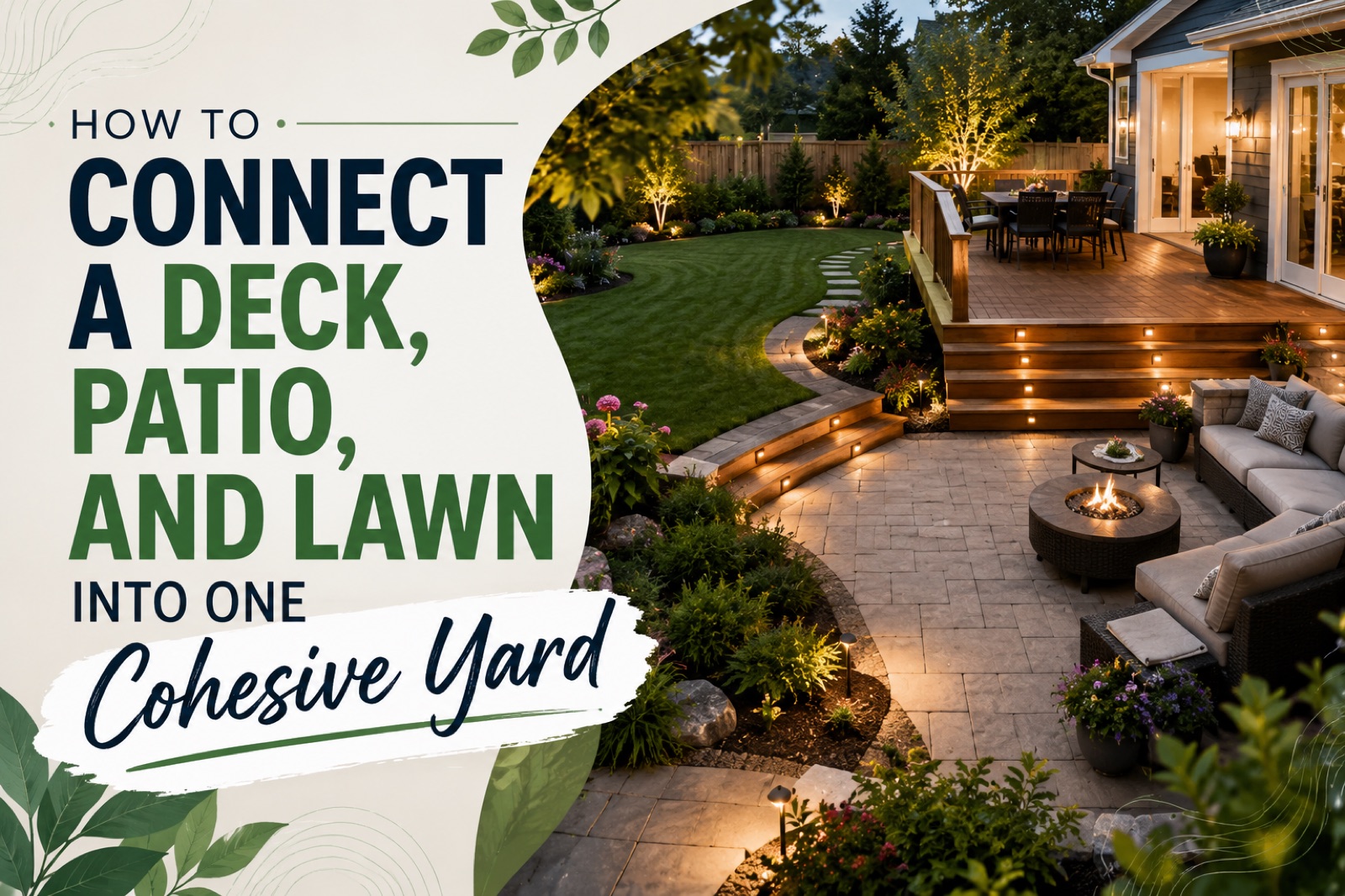
A deck, patio, and lawn can each look great on their own and still make a backyard feel disconnected.
The problem usually is not the individual features. It is what happens between them.
A deck may sit several feet above a patio. The patio may end abruptly against the grass. Steps might send people toward a planting bed instead of the lawn. Materials may change three times within a few feet. When these transitions are not planned together, the yard starts to feel like separate projects completed at different times.
A cohesive yard works differently. The deck, patio, lawn, planting, and pathways form one continuous outdoor experience. Each area can have a different purpose, but there should be a clear visual and physical relationship between them.
Here is how to create that connection.
Start With How People Will Move Through the Yard
Before choosing pavers, plants, railings, or furniture, trace the most common route through the space.
A typical backyard might flow like this:
House → deck → steps → patio → lawn → garden
That route should feel obvious without requiring someone to stop and figure out where to walk next.
Look at where the home's doors open, where people naturally enter the yard, and which areas they use most frequently. A deck beside the kitchen might function as the dining area, while a lower patio becomes the lounge or fire pit zone and the lawn remains open for children, pets, or recreation.
Once those functions are clear, connecting them becomes much easier.
If you are still determining the overall layout, Easy Ways to Give Your Yard a More Professional Layout explains how clear zones and circulation can make the entire landscape feel more intentional.
Treat the Deck and Patio as Two Levels of the Same Outdoor Room
One of the most common design mistakes is treating the deck and patio as unrelated spaces. Instead, think of them as two floors within the same outdoor living area. For example:
- The deck can handle dining and grilling close to the house.
- The patio can provide lounge seating or a fire feature.
- The lawn can remain the open recreation zone.
The spaces do not need identical furniture or materials. They simply need enough visual continuity that they feel related.
That might come from repeating the same furniture color, planter style, wood tone, stone color, or planting palette across both levels.
A dark deck railing, for example, could be repeated in black patio furniture or landscape lighting below. Warm wood decking might be paired with warm-toned pavers rather than a cool gray material that feels completely unrelated.
Small repetitions often create more cohesion than trying to make every surface identical.
Make the Deck-to-Patio Transition Feel Intentional
Elevation changes deserve particular attention. If a raised deck simply ends with a narrow staircase landing in the middle of a patio, the connection can feel awkward. Instead, make the transition part of the design. Wide steps often feel more integrated than a narrow staircase because they visually connect the two levels. Depending on the available space, you could also use:
- Broad platform steps
- A generous intermediate landing
- Built-in planters alongside stairs
- Low retaining walls
- Integrated bench seating
- Planting around the stair base
The goal is to make the elevation change feel designed rather than purely functional. Also consider where the stairs land. Ideally, they should open into a clear circulation area rather than directly into the back of a sofa, dining table, grill, or planting bed.
Use the Patio as the Bridge Between Deck and Lawn
In many yards, the patio is the physical transition between the more architectural deck and the softer lawn. That makes its shape especially important.
A rigid rectangle can work well with contemporary architecture, but its edges should still relate to the surrounding yard. A patio that extends too far into a small lawn can make the grass look like leftover space.
Instead, consider the patio and lawn shapes together. If the patio extends outward in one area, the lawn can wrap around it. If the yard is narrow, keeping a cleaner linear edge may preserve more usable grass.
Avoid creating tiny strips of lawn that are difficult to mow or have no functional purpose.
For more on matching patio dimensions and placement to the surrounding landscape, see How to Create a Patio That Fits Your Outdoor Space Better.
Do Not End the Patio Abruptly at the Grass
The line between patio and lawn is one of the easiest places for a yard to start looking unfinished. You have several options for making the transition softer.
Use a Planting Border
A narrow planting bed can create a visual buffer between hard paving and lawn. Low ornamental grasses, groundcovers, flowering perennials, or compact shrubs can soften the patio edge without blocking views across the yard. You do not necessarily need planting around the entire patio. Even a bed along one or two sides can help anchor it into the landscape.
Add a Gravel Transition
A thin gravel border can work particularly well with modern or informal landscapes. It creates a subtle material transition between paving and grass while providing drainage and a clean edge.
Use Stepping Stones
If people regularly move between the patio and another area of lawn, a few large stepping stones can extend the visual language of the hardscape farther into the yard. This prevents the patio from feeling as though it simply stops.
Repeat Materials Without Making Everything Match
Cohesion does not mean using one material everywhere. A wooden deck, stone patio, and green lawn are naturally different. Trying to make them look identical defeats the purpose of having distinct outdoor zones. Instead, repeat selected details. For example, a yard might use:
- Deck: warm brown composite boards
- Patio: neutral pavers with warm undertones
- Path: gravel containing similar warm colors
- Planters: dark charcoal
- Furniture: charcoal frames with neutral cushions
The surfaces remain different, but the palette connects them. This principle also applies to plants. Rather than introducing completely different planting styles beside every area, repeat several key plants throughout the landscape. The same ornamental grass might appear beside the deck stairs, patio edge, and far lawn border. Repetition helps the eye recognize the entire yard as one composition.
For a deeper look at balancing built surfaces with planting, read The Best Way to Combine Hardscape and Plants in One Design.
Keep the Lawn as an Intentional Shape
The lawn is often treated as whatever space remains after the deck, patio, beds, and pathways have been added. That usually produces awkward landscaping. Instead, design the lawn as its own shape. A good lawn should ideally have:
- Clean, understandable edges
- Enough width to be useful
- Easy mowing access
- Few unnecessary narrow strips
- A clear relationship with the patio and planting beds
If your patio pushes into the lawn in several unrelated directions, simplify the boundary. A strong curve or clean straight line usually looks better than several small bumps and indentations. Think of the lawn as a visual breathing room between harder landscape elements.
Use Planting to Stitch the Three Areas Together
Plants are one of the most effective tools for making deck, patio, and lawn areas feel connected. Rather than creating one isolated bed next to each feature, use planting that visually travels through the yard.
For example, begin with taller shrubs around the deck, continue with medium-height grasses or flowering plants beside the patio, then transition to lower plants near the lawn.
This creates a gradual change in scale. Layering also prevents the yard from looking flat. A simple structure might include:
- Back layer: small trees, tall shrubs, screening plants
- Middle layer: flowering shrubs, grasses, structural perennials
- Front layer: groundcovers, low perennials, edging plants
Repeating some of these plants in several locations produces unity without making every bed identical.
Plan Furniture Before Finalizing the Connections
Furniture affects circulation more than many homeowners expect. A staircase that appears perfectly positioned on an empty patio might become inconvenient once a dining set or sectional is added. Leave adequate movement space between:
- Deck doors and furniture
- Deck stairs and patio seating
- Dining chairs and patio edges
- Grills and circulation paths
- Patio seating and lawn access
Do not make people squeeze between furniture just to reach another part of the yard. The guide How to Plan Outdoor Furniture Before Finalizing Your Patio Size can help you determine these dimensions before hardscape is installed.
Use Lighting to Continue the Flow After Dark
A connected landscape should remain understandable at night. Lighting can visually link each outdoor zone while making transitions safer. Consider combining:
- Step lights on the deck
- Soft lighting around the patio
- Path lights between patio and lawn
- Uplighting on repeated trees or shrubs
- Subtle lighting near important changes in elevation
Use restraint. The goal is not to illuminate every square foot. Instead, establish a sequence of light that guides someone from the house through the deck, patio, and landscape.
Make Drainage Part of the Connection
Decks, patios, and lawns handle rain very differently. Water can pass through deck boards, while a conventional patio sends much more rainfall across its surface. The lawn may absorb some water but can become saturated if runoff is concentrated in one area. Before finalizing the layout, determine:
- Where deck runoff reaches the ground
- Which direction the patio slopes
- Whether patio water is being pushed onto the lawn
- Whether low areas will collect water
- Where downspouts discharge
- Whether planting beds interrupt drainage routes
Never create visual cohesion at the expense of proper drainage. A beautifully connected patio and lawn will quickly become frustrating if the lawn beside them remains muddy after every storm.
Design Important Views From Inside the House Too
Your yard is not only experienced while standing outside. Look through the doors and windows that face the backyard. Ask what you see first.
Ideally, the deck, patio, lawn, and planting should create visual depth rather than showing one large surface directly outside the window. A strong view might move from:
Deck furniture → patio feature → lawn → layered planting or a specimen tree
This encourages the eye to travel through the entire property and can make even a modest yard feel larger.
Common Mistakes That Make a Yard Feel Disconnected
Several problems appear repeatedly in deck-patio-lawn layouts.
- Using completely different materials in every area: Variety is useful, but without shared colors or details the yard can become visually fragmented.
- Making pathways too narrow: Connections between outdoor zones should feel comfortable, especially where several people may move at once.
- Ignoring furniture during planning: Seating can block circulation that looked perfectly clear on the original plan.
- Leaving hardscape edges completely exposed: Planting, gravel, or intentional edging often helps patios settle into the landscape.
- Treating the lawn as leftover space: A lawn with an awkward shape makes the entire yard appear less considered.
- Adding each feature separately: Designing the deck first, patio several years later, and planting afterward can work, but only if each phase follows an overall plan.
The Best Way to Make the Whole Yard Feel Cohesive
You do not need the deck, patio, and lawn to look the same. You need them to relate to one another. The strongest yards usually share a few characteristics:
- Movement between areas feels natural.
- Materials repeat in subtle ways.
- Changes in elevation look deliberate.
- Patio edges transition smoothly into lawn and planting.
- Furniture does not interrupt circulation.
- Planting appears throughout the landscape rather than in isolated pockets.
- Drainage is considered before surfaces are installed.
When those elements are planned together, the deck becomes an extension of the house, the patio becomes an extension of the deck, and the lawn becomes an intentional part of the outdoor living space rather than the area left over.
See the Whole Yard Before You Build It
Connecting several outdoor zones can be difficult to judge from measurements alone. With iScape, you can visualize how a deck, patio, lawn, pathways, furniture, and planting work together before making permanent changes.
Try different patio shapes, adjust planting beds, move furniture, and look at the complete yard as one design. It is much easier to fix an awkward connection while you are planning than after the deck stairs, pavers, and landscape beds are already installed.
Frequently Asked Questions
Should a patio connect directly to a deck?
It can, but the transition should account for elevation, circulation, drainage, and furniture placement. Wide steps or a landing can often make the connection feel more intentional.
How do you soften the transition from a patio to a lawn?
Planting beds, low groundcovers, gravel borders, stepping stones, and clean edging can make the change from hardscape to grass feel more natural.
Should deck and patio materials match?
They do not have to match. Coordinating colors, finishes, furniture, railings, or other repeated details is usually enough to create visual continuity.
How much lawn should you keep around a patio?
There is no fixed percentage. Keep enough lawn for how you actually use it and avoid narrow leftover grass strips that are difficult to maintain or serve no purpose.
What should be planned first: the deck, patio, or landscaping?
Plan the overall yard layout first. Decide how each area will function and connect before finalizing the dimensions and materials of individual features.