If you have ever managed a landscape project inside an HOA community, you already know the approval process can feel like its own mini project. It has paperwork, timelines, subjective design standards, and a review committee that may meet only once or twice a month. When the application is unclear or incomplete, even a small request can turn into weeks of back and forth.
This matters because HOAs are not a niche scenario anymore. The Foundation for Community Association Research (linked to Community Associations Institute) estimates there are roughly 369,000 community associations in the U.S., with about 77.1 million residents. That is a huge share of homeowners and a huge share of landscape work.
The good news is that most HOA delays are predictable, which means they are preventable. Faster approvals usually come from three things: submitting the right documents the first time, presenting the design in a format the committee can understand quickly, and managing communication so your request stays moving through the queue.
This guide explains the workflow professionals use to speed up HOA approvals for landscaping, hardscaping, planting, lighting, and outdoor living projects, while reducing revisions and avoiding costly rework.
Know What the HOA Is Actually Reviewing
Most HOAs route exterior changes through an Architectural Review Committee (ARC), Architectural Review Board (ARB), or Architectural Control Committee (ACC). These committees are typically empowered by the community’s governing documents, often the CC&Rs plus separate architectural guidelines and standards.
In practical terms, they tend to evaluate three things:
Appearance and consistency with the community
They look for visual alignment with the neighborhood’s style, approved color palettes, material standards, and visibility from the street or common areas. Many HOA guidelines specifically say exterior changes require written approval and must be applied for before installation.
Impact on neighbors and shared property
They often ask whether the project affects drainage, sightlines, privacy, noise, or access. Landscaping can trigger extra scrutiny when it changes grading, adds retaining walls, relocates downspouts, or alters runoff patterns.
Completeness and compliance of the application
Committees frequently delay applications that are missing required documents or specifications. Multiple industry and HOA resources point to incomplete submissions as a top cause of delays and denials.
If you want faster approval, you have to design and document your work the way the committee reviews it, not just the way you would present it to a client.
Understand the Timeline So You Can Plan Around It
HOA decision windows vary, but many communities operate on a defined response period set by governing documents. It is common to see windows in the range of 30 to 60 days, depending on how often the committee meets and whether the packet is considered complete.
There are two timeline traps that slow projects down.
Trap 1: The clock often starts only after the packet is “complete”
Some management companies log submissions, then request missing items, and only then treat the application as officially received for review. If you submit a partial packet, you may lose one or two weeks before review even starts.
Trap 2: Seasonal backlogs are real
Spring and early summer often bring a flood of applications. Even if the written timeline says 30 days, the real timeline can stretch when the committee has a queue.
For professionals, the takeaway is simple. If you want to start the build on a predictable date, you need to treat HOA approval as a lead time item, just like pavers, lighting fixtures, or custom materials.
Start With the HOA Rules Before You Start the Design
The fastest approvals come from designs that do not trigger questions. You get there by building within the rules from the beginning, not by designing first and negotiating later.
Find the exact documents that control landscaping changes
Look for these items:
- CC&Rs sections on architectural control and landscaping
- Architectural guidelines or design standards
- ARC application forms and submittal checklists
- Approved plant lists or prohibited plant lists (some communities publish these)
- Irrigation and drainage rules, if the HOA has them
- Any city or county rules that interact with the project, especially for walls, drainage, or lighting
Many HOAs publish guidelines that require specific plans such as site plans, drainage plans, irrigation plans, and landscaping plans, along with photos and specifications.
Identify “automatic delay” triggers in the rules
Before you finalize a concept, scan for common restriction categories:
- Front yard turf limits or minimum planting coverage
- Height restrictions for hedges and screens
- Tree placement rules near sidewalks or utilities
- Approved mulch and rock types
- Fence and wall height limits, plus finish requirements
- Lighting restrictions (brightness, fixture style, placement)
- Restrictions on artificial turf or certain plant species
- Drainage rules and requirements to avoid runoff onto neighboring lots
When you design inside these boundaries, you reduce the chance of a rejection that requires redesign, resubmission, and another full review cycle.
Build an HOA-Ready Submission Packet
Think of your packet as a fast decision tool for the committee. They should be able to answer “Is this compliant?” without guessing. While requirements vary, HOA documents often ask for the same core items: a clear scope description, a plan that shows location and dimensions, materials and colors, and enough site context to understand impact.
What to include for faster approvals
1) A short project summary that matches HOA language
Write a paragraph that includes:
- What you are changing
- Where it is located (front yard, side yard, rear yard)
- Why you are doing it (privacy, drainage correction, curb appeal, safety)
- What materials you will use
- Whether it changes grading or drainage
This helps the reviewer categorize your request quickly and reduce follow-up questions.
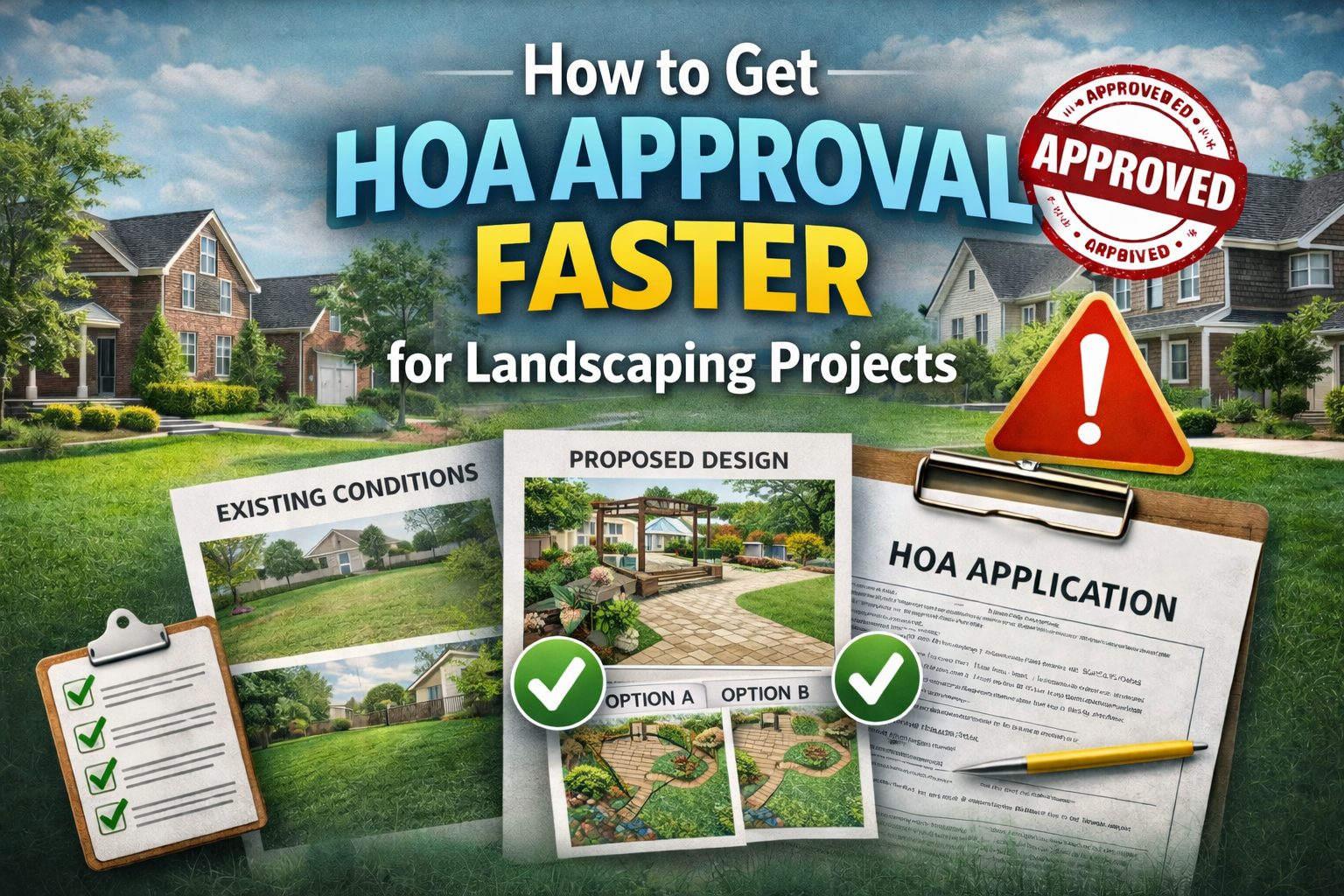
2) Existing conditions photos with labels
HOA reviewers are not on-site. Photos reduce ambiguity, especially for slopes, visibility from the street, and proximity to neighbors. Include 4 to 8 photos, labeled by view, and reference them on the plan if possible.
3) A site plan with measurements
Your plan should clearly show:
- Property lines and easements if required
- Existing structures and hardscape that remain
- Proposed additions with dimensions
- Setbacks where relevant
- Locations of trees, beds, walls, patios, and fences
Even for “small” projects, a scaled plan cuts down review time because it prevents committee members from asking, “How big is it?” or “Where exactly is it going?”
4) A planting plan that does not raise questions
If the HOA has an approved plant palette, use it. If the HOA does not have one, choose plants that look consistent with the neighborhood and that fit mature size constraints. Your planting plan should list:
- Plant name (common and botanical if possible)
- Quantity
- Size at installation (pot size or caliper)
- Spacing
- Placement on the plan
Some HOA guidelines explicitly ask for species and quantity shown on a landscape plan.
5) Materials board, cut sheets, and color samples
Committees want to confirm visual consistency. Many HOAs keep preapproved materials and colors available for reference, and they often expect your submission to match those standards. Include manufacturer links or spec sheets for:
- Pavers and coping
- Wall blocks and caps
- Edging
- Mulch or rock
- Lighting fixtures
- Pergola materials or stain colors, if included
6) Drainage and grading notes when relevant
Drainage is a common reason committees pause approvals because water movement affects neighbors. If your project changes grades, adds impermeable area, or alters downspout discharge, include a short drainage note and, when needed, a drainage sketch that shows direction of flow. Many HOA and community guidelines specifically warn against changes that could impact drainage patterns.
7) Contractor details, schedule, and insurance if required
Some HOAs want contractor license numbers, insurance certificates, and a rough schedule. Even when optional, providing this information can make your packet feel complete and lower perceived risk.
Use Visuals That Help the Committee Approve Faster
Committees often review multiple requests in a meeting. A packet that is easy to understand tends to move faster because it reduces discussion time and reduces the need to “table” your request. This is where visual design tools can make a real difference.
How iScape helps speed up HOA approvals
Landscape approvals slow down when decision makers cannot visualize scale, placement, and finished appearance. When you provide clear visuals, you reduce uncertainty, and uncertainty is what causes deferrals and revision requests.
Using iScape, you can create a realistic concept on a photo of the actual property, test options quickly, and share a clearer view of what you are proposing. iScape also has content focused on how visual design apps can help projects get approved faster, including HOA review considerations like renderings, materials, and supporting documents.
Professionals use iScape to support HOA submissions by:
- Creating before and after visuals to show street-facing impact
- Presenting two compliant options so the committee can choose a safer path
- Aligning client expectations early, which reduces last-minute changes after approval
- Providing a visual reference that complements your plan set and materials list
Download iScape on the App Store or Google Play Store today and start designing today!
Avoid the #1 Cause of Delay: Incomplete Submissions
If you want the most reliable way to shorten approval time, this is it. Multiple HOA and industry resources point out that incomplete submissions are a top reason requests get delayed or denied because the committee cannot review what it cannot verify. Professionals prevent this by building a repeatable internal checklist.
A practical “complete packet” test
Before you submit, ask:
- Can a reviewer tell exactly what is changing without calling me?
- Can they confirm size, placement, and visibility from the street?
- Can they verify materials and colors without guessing?
- Can they see how drainage is handled, if the project affects it?
- Can they confirm compliance with the written guidelines?
If any answer is “no,” your packet is at risk of getting kicked back for clarification.
Submit Like a Pro: Small Steps That Reduce Waiting
Ask how the committee prefers submissions
Some HOAs accept email submissions, others require portals, and some need physical copies. Submit in the format they prefer, because format mistakes can create avoidable delays.
Request written confirmation of receipt and completeness
You want a simple confirmation that the packet was received and is considered complete. This matters because the review timeline often depends on when an application is officially logged.
Be proactive about meeting dates
Ask when the next committee meeting is scheduled and whether your packet will be included. If you miss the cutoff by one day, you might lose two to four weeks depending on meeting frequency.
Keep the communication professional and minimal
Friendly, clear, and direct messages tend to move faster than long explanations. When committees need clarification, respond quickly and attach the revised page, not a full new packet unless requested.
Design Strategies That Get Approved Faster
Even with a perfect packet, the design itself can slow approval if it triggers subjective concerns.
Stay within established neighborhood patterns
HOAs are built to maintain a consistent look. When your design aligns with existing community patterns, reviewers often feel safer approving it. That means:
- Using materials that match other homes
- Keeping front-yard designs clean and not overly complex
- Avoiding high-contrast colors and unusual finishes
- Choosing plants that look appropriate for the neighborhood
Use “compliance-first” options for visible areas
Street-facing areas are judged more strictly. If the front yard is the risk zone, use conservative choices there, and put bolder features in private areas where visibility is limited.
Provide an option set when you expect a debate
If you suspect the committee may object to one feature, provide two compliant alternatives upfront. It feels like you are helping the committee make an easy decision instead of forcing a negotiation. iScape makes this approach faster because you can create two visual options quickly and include them as part of your submission packet.
If You Get a Revision Request, Respond the Right Way
Revision requests are not always a rejection. Often, they are the committee’s way of pushing your request toward what they can approve.
Respond with a “what changed” summary
When you resubmit, include a short note:
- What you changed
- Which guideline the change addresses
- Which pages are updated
This reduces re-review time because reviewers do not need to re-read everything.
If you are denied, ask for the specific guideline reference
Many experts recommend reviewing the written denial reason and identifying the rule that triggered it, then adjusting your plan accordingly and resubmitting or appealing if allowed. This keeps the conversation grounded in documents, which is usually the fastest path forward.
A Realistic Approval Workflow for Landscape Pros
Here is a professional workflow that keeps projects moving without surprise delays:
- Collect HOA docs, application forms, and submittal checklist
- Survey site conditions and document existing issues like drainage and visibility
- Create a compliant concept and produce clear visuals using iScape
- Lock selections early, especially hardscape and lighting
- Assemble a complete packet with plans, photos, and specs
- Submit in the HOA’s preferred format and confirm completeness
- Track meeting dates and respond quickly to clarifications
- Receive approval, then schedule ordering and installation with the approval date as the start of procurement
This approach reduces the risk of a second review cycle, which is where timelines usually get painful.
How iScape Fits Into Faster HOA Approvals
HOA committees approve what they understand, and they delay what feels unclear or risky. The fastest way to reduce that uncertainty is to give them a view of the finished project that matches the written rules and your plan dimensions.
iScape helps you do that by making it easier to create visuals that clients and committees can understand quickly, which reduces revision loops and speeds decision-making.
Download iScape on the App Store or Google Play Store today and start designing today!