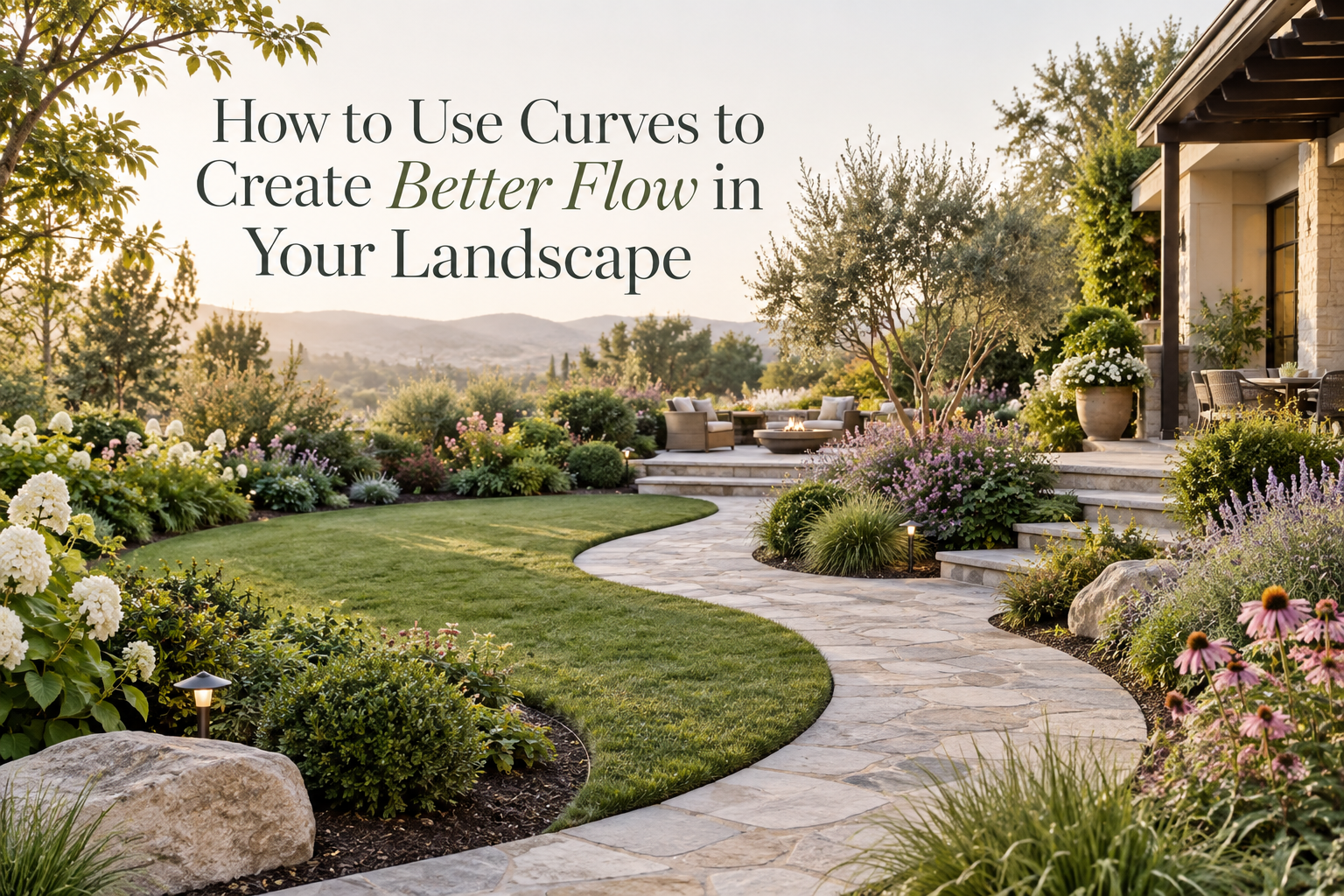
Curves can make a landscape feel softer, more natural, and easier to move through, but only when they have a clear purpose.
A curved path can slow movement and reveal the yard gradually. A curved planting bed can soften the edge of a lawn or patio. A broad arc can also help connect areas that would otherwise feel separate.
Problems begin when curves are added simply because straight lines feel too formal. Too many bends can make a yard look restless, reduce usable lawn space, complicate mowing, and create awkward planting areas.
The goal is not to make every edge curved. It is to use curves where they improve movement, soften transitions, or respond naturally to the shape of the property.
Start With Function Before Drawing the Curve
Before adding a curved pathway, lawn edge, or planting bed, ask what the curve needs to accomplish.
A curve might direct people toward an entrance, move around an existing tree, connect two outdoor areas, soften a large paved surface, or create a slower route through a garden.
If the curve does not improve movement or the way the space is organized, it may not be necessary.
A pathway that gently moves around a mature tree has an obvious reason for changing direction. A path that repeatedly moves left and right across an open lawn usually feels artificial.
This is also why clean lines and a consistent landscape layout matter even when the overall design is informal. Curves should still look deliberate and relate to the rest of the yard.
Use Long, Gentle Curves Instead of Small Bends
One of the easiest ways to make curves look intentional is to use fewer, broader arcs.
Large-radius curves are easier for the eye to follow and tend to create stronger movement through the landscape.
Small waves and repeated bends often create visual clutter.
Imagine a lawn edge containing six shallow bumps across a relatively short distance. Each change in direction attracts attention and makes the boundary feel unnecessarily complicated.
Now imagine the same edge following one broad sweep.
The second approach creates movement without making the landscape busy.
The same principle applies to pathways, planting beds, retaining walls, and patio edges. Whenever possible, use one confident curve instead of several small ones.
Let Paths Curve for a Reason
Paths are one of the most effective places to use curves because they directly influence how people move through the yard.
Straight paths communicate efficiency. They usually make sense when someone needs a direct route between important destinations.
Curved paths create a different experience. They can slow movement, introduce views gradually, and make a garden feel deeper because the entire route is not visible at once.
However, the route still needs to feel logical.
If the walkway from a gate to a patio makes an unnecessary detour, people may eventually ignore it and cut across the lawn.
A curve works best when something justifies the change in direction, such as a mature tree, planting bed, seating area, water feature, focal plant, or change in elevation.
When planning pathways and plant placement together, it also helps to consider mature plant size. A path that initially feels generous can become narrow once surrounding shrubs and grasses spread.
Use Curves to Reveal the Landscape Gradually
Curved paths can also control what someone sees as they move through the property.
A straight route often reveals the destination immediately.
A curved path can partially hide a seating area, garden feature, or secondary outdoor space until someone moves farther into the yard.
This can make the landscape feel larger and more layered.
For example, a path could move beside ornamental grasses before gently turning toward a small seating area. Instead of seeing the entire garden from one position, the experience changes as you move through it.
However, do not hide important safety or orientation features. Steps, gates, entrances, and major changes in elevation should remain easy to understand.
Use Curves to Soften Large Lawn Areas
Curved planting beds can make a rectangular lawn feel less rigid.
They work particularly well along fences, patios, property boundaries, and corners where straight edges can make the yard feel boxy.
A broad bed extending gently into the lawn can also create enough depth for layered planting rather than leaving plants in a narrow strip along the boundary.
However, every curve affects the shape of the remaining lawn.
If the lawn is used for children, pets, games, or gatherings, avoid designing beds that divide it into awkward sections.
The lawn should remain a deliberate shape rather than whatever space happens to remain after planting beds are drawn.
Do Not Make Curves Hard to Maintain
A landscape can look attractive on paper and still become frustrating to maintain.
Tight inside corners can be difficult to mow. Small wedges of grass may require trimming by hand. Narrow planting pockets can become overcrowded once plants mature.
Before finalizing a curved edge, imagine how a mower, wheelbarrow, hose, or maintenance worker will move through the area.
Broad, smooth transitions generally require less maintenance than highly detailed edges.
A good curve should improve both the appearance and usability of the yard rather than create extra work.
Repeat the Same Curve Language
Consistency helps curved landscapes feel intentional.
If one planting bed follows a broad natural arc while another uses tight semicircles and a third has sharp geometric angles, the yard may start to feel disconnected.
You do not need to repeat the exact same curve everywhere.
Instead, repeat the general character of the line.
For example, if the main lawn edge uses broad arcs, a nearby pathway might follow a similarly relaxed curve.
This creates rhythm and helps different sections of the landscape feel as though they belong to one design.
Combine Curves With Straight Lines
A landscape does not need to be entirely curved or entirely straight.
In many yards, combining the two creates the strongest result.
Architecture usually provides straight lines through the house, fence, deck, driveway, and patio. The landscape can then introduce softer curves where they make sense.
A rectangular patio might meet a gently curved planting bed.
A straight walkway near the house might transition into a curved garden path farther into the yard.
A linear fence can remain simple while planting in front of it follows a broad arc.
This contrast allows the landscape to feel softer without disconnecting it from the architecture.
Use Curves to Connect Outdoor Zones
Curves become especially useful when a yard contains several functional areas.
A property might include a deck, patio, lawn, fire pit, garden, and secondary seating area.
If every space is treated as an isolated shape, the backyard can feel like several unrelated projects.
A curved pathway or planting bed can visually connect them.
For example, a planting bed might begin beside the patio, continue along the edge of the lawn, and gradually lead toward a seating area.
The principle is similar to connecting a deck, patio, and lawn into one cohesive yard. Different areas can serve separate functions while movement, planting, materials, and transitions help them feel like parts of one landscape.
Use Planting to Reinforce the Curve
Plants can strengthen a curved layout without making the design feel overly formal.
Avoid placing every plant at identical intervals directly along the edge.
Instead, allow planting groups to move slightly forward and backward within the bed.
Larger shrubs or grasses can emphasize important sections of the curve, while groundcovers and lower perennials can soften the edges.
Repeated planting also helps guide the eye.
For example, several groups of the same ornamental grass placed along a curved bed can visually carry the viewer through the landscape without creating a rigid row.
Plant height should also support the view. Taller plants can frame certain sections, while lower plants can preserve sightlines toward patios, lawns, entrances, or other important features.
Use Curves Carefully in Small Yards
Curves can make compact yards more interesting, but too many can quickly reduce usable space.
A deep curved planting bed may leave an awkward patch of lawn.
A winding pathway may consume much more space than a direct route.
Small yards usually benefit from restraint.
One broad curve along a planting bed may provide enough softness to balance a rectangular patio or house.
The objective is to create movement without forcing curves into every available area.
Avoid Curves That Have No Destination
Every important landscape line should lead somewhere or respond to something.
A curved pathway should normally connect destinations such as a patio, garden gate, shed, seating area, fire pit, or another part of the yard.
If it disappears behind planting and leads nowhere, the design can become confusing.
Planting-bed curves should also relate to surrounding features rather than creating arbitrary bumps in the lawn.
When a curve has a clear reason to exist, people tend to perceive it as part of the landscape naturally.
Test Curves Before Making Them Permanent
Curves can be difficult to judge from a drawing alone.
Before installing permanent edging, planting, or paving, mark the proposed line directly on the ground.
A garden hose, rope, marking paint, or stakes can help you experiment with different shapes.
Then view the line from several important positions, including the house, patio, driveway, windows, and main walking routes.
Ask whether the curve still looks smooth from a distance and whether it improves movement through the space.
This is also where iScape can help. Homeowners and landscape professionals can test pathways, planting beds, hardscape, and other landscape elements visually before making permanent changes.
Final Takeaway
Curves create better landscape flow when they help people move, connect spaces, soften hard edges, or reveal different parts of the yard gradually.
They work best when they are broad, purposeful, and consistent.
Avoid adding bends simply to make the landscape look more natural. Too many curves can reduce usable space, increase maintenance, and make the yard harder to understand.
Start with the major outdoor zones and circulation routes. Decide where movement should remain direct and where a softer transition would improve the landscape.
Then use a few strong curves to connect those areas.
The most successful curved landscapes do not look as though every line was deliberately made curved. They simply feel comfortable and natural to move through because each curve has a reason to be there.
Download iScape: Available for iPhone and iPad on the App Store and Android on Google Play. The app supports homeowners and landscape professionals who want to plan and visualize outdoor projects before installation.