


Native Plants vs. Traditional Ornamentals: What Works Better in Your Yard?
July 28, 2026
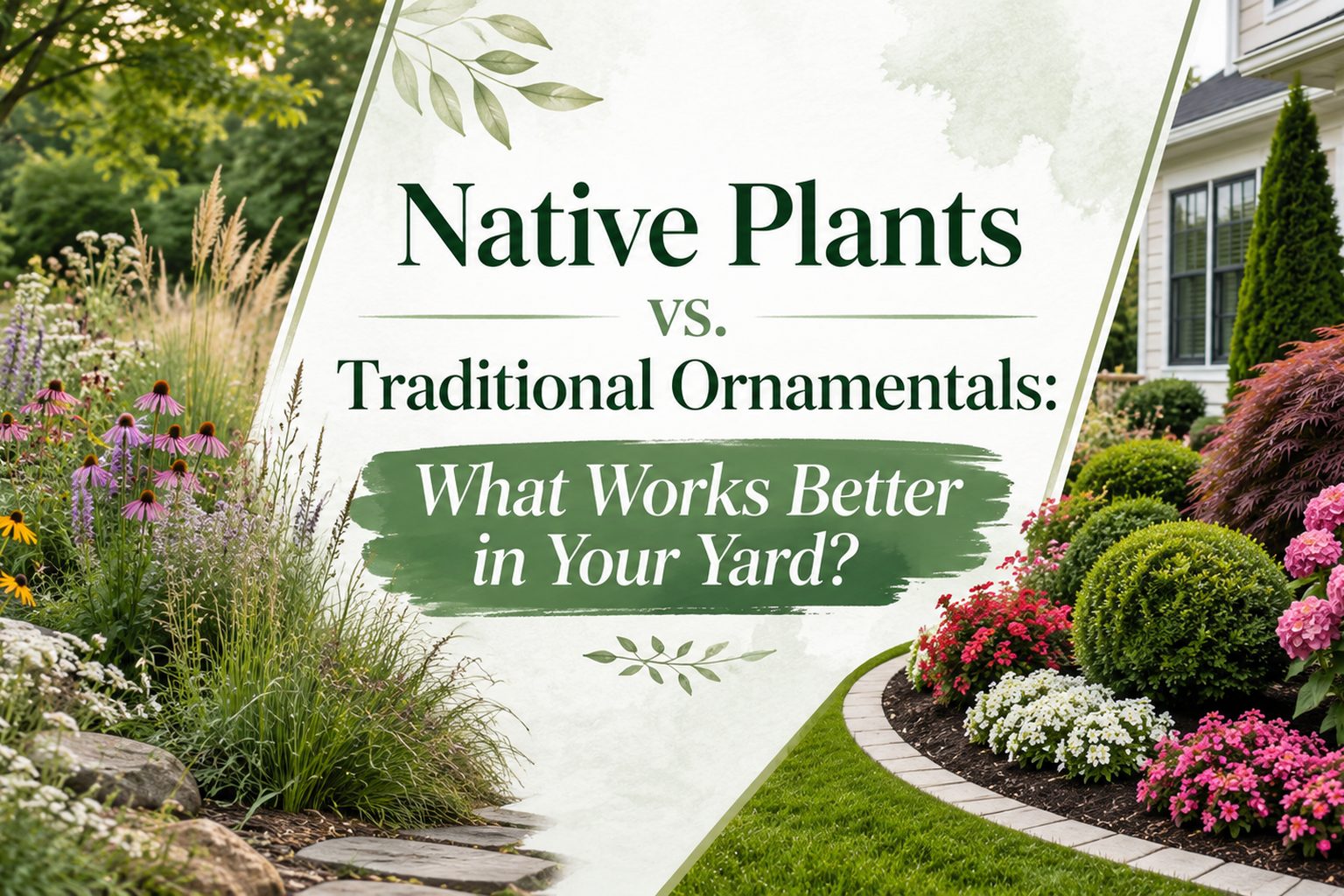
Walk through almost any garden center and you will find two broad categories of plants competing for attention. One section may feature native grasses, flowering perennials, shrubs, and trees associated with the local landscape. Another may be filled with familiar ornamentals selected for their large flowers, colorful foliage, tidy growth, or long blooming periods.
Both can look beautiful. Both can also fail when planted in the wrong place. The real question is not whether native plants are always better than traditional ornamentals. It is which plants will perform best in your specific yard while meeting your goals for appearance, maintenance, water use, wildlife, and long-term cost.
For many homeowners, the strongest landscape is not completely native or completely ornamental. It uses locally appropriate native plants as the foundation, then adds carefully selected, non-invasive ornamentals where they provide a useful design benefit.
What Is the Difference Between Native Plants and Traditional Ornamentals?
A native plant is generally understood as a species that developed naturally within a particular region before being introduced there through human activity. However, the word “native” should always be considered geographically. A plant native to the United States is not automatically native to every state, county, or ecological region. A species that grows naturally in Arizona may struggle in a wet Pennsylvania yard, even though both locations are in the same country. Local soil, rainfall, temperatures, elevation, and seasonal patterns still matter.
Traditional ornamentals are plants grown mainly for their visual or functional value. They may be chosen for colorful flowers, evergreen foliage, privacy screening, compact growth, fragrance, shade, or formal structure. Some traditional ornamentals are native species that have been bred for particular characteristics. Others come from different regions or countries. Among nonnative plants, there are three important distinctions:
- Adapted nonnative plants grow successfully in the local climate without excessive water, fertilizer, or pest control.
- Invasive plants spread aggressively outside gardens and disrupt surrounding natural areas.
- Well-behaved ornamentals may be nonnative but remain controlled within the landscape.
This distinction matters because “nonnative” and “invasive” do not mean the same thing. A nonnative plant can be useful and manageable, while an invasive plant can create problems far beyond the property where it was originally planted.
Why Native Plants Often Perform Better
Native plants have developed alongside the climate, soil organisms, insects, birds, and seasonal conditions of their home region. When they are planted in conditions similar to their natural habitat, this local adaptation can provide several practical advantages. However, native status alone does not guarantee success.
A moisture-loving native planted in a hot, dry driveway bed can struggle just as badly as an unsuitable ornamental. The basic landscaping principle still applies: choose the right plant for the right place. The iScape guide on choosing the right plants for sun, shade, soil, and space can help you evaluate the actual conditions in each section of your yard before selecting plants.
They May Need Less Water After Establishment
A native plant suited to the site is usually adapted to the region’s normal rainfall pattern. In dry regions, native plants may have deep roots, smaller leaves, seasonal dormancy, or other features that help them survive long periods without rain. In wetter areas, local natives may be better prepared for seasonal moisture and humidity.
Once established, suitable native plants may require less supplemental irrigation than ornamentals from climates with very different rainfall patterns. This does not mean they never need water. Newly planted native trees, shrubs, grasses, and perennials generally need consistent watering while their root systems become established. Local adaptation also matters more than the native label itself. A plant native to a wet meadow will not automatically perform well in a dry foundation bed.
They May Require Less Fertilizer
Many native species can grow successfully in local soils without intensive feeding. Ornamental plants bred for unusually large flowers, rapid growth, or continuous blooming may require richer soil or more regular fertilization. This is not true of every ornamental, but it is an important factor to check before purchasing.
When plants are matched to their natural soil and moisture conditions, they are also less likely to become stressed. Healthy, well-placed plants usually require fewer corrective treatments than plants constantly struggling with unsuitable conditions.
They Can Support Local Wildlife
Native plants can support birds, butterflies, bees, moths, and other wildlife in several ways. Some provide nectar or pollen. Others produce seeds, berries, nuts, or fruit. Native grasses and shrubs may offer shelter, nesting material, or protected areas close to the ground.
Many insects also depend on specific native plant species during their larval stages. A flowering ornamental may provide nectar for an adult butterfly, but it may not provide food for the caterpillar that comes before it. A wildlife-friendly yard therefore needs more than flowers. It may also need host plants, shrubs, trees, grasses, fallen leaves, seed heads, and protected nesting areas. For a broader approach to environmentally responsible yard planning, explore these eco-friendly landscape ideas for a sustainable garden.
They Give the Yard a Stronger Regional Identity
A landscape filled only with common nursery plants can sometimes look almost the same in Florida, Ohio, Colorado, and California. Regional native plants help connect a yard to the surrounding environment.
A Southwestern yard may use drought-adapted flowering plants, open forms, and native grasses. A woodland garden in the eastern United States may feature layered shrubs, ferns, spring flowers, and shade-tolerant groundcovers. The result does not have to look wild or uncontrolled. Native plants can be arranged in repeated groups, formal borders, edged planting beds, modern layouts, or clean foundation plantings. The design style determines whether the yard feels natural, formal, modern, cottage-inspired, or somewhere in between.
Where Traditional Ornamentals Can Have an Advantage
Native plants provide meaningful benefits, but traditional ornamentals remain popular for practical reasons. Many have been selected or bred to provide predictable garden performance.
- More Predictable Size and Shape
Some ornamentals are developed to maintain a compact, upright, rounded, narrow, or weeping form. This can make them useful beside walkways, near foundations, under windows, around patios, or in small yards where mature size is a major concern. A naturally occurring native species may become too tall, spread too widely, or behave too loosely for a tight space. A compact ornamental or cultivated native variety may be easier to fit into that area. However, labels such as “dwarf” and “compact” should not be mistaken for “small.” Always check the expected mature height and width rather than judging the plant by the size of its nursery pot.
- Longer or More Consistent Color
Traditional annuals and flowering ornamentals are often selected for extended bloom periods. They can provide immediate color while slower native perennials are becoming established. They can also fill seasonal gaps when few local plants are flowering. Ornamentals may offer foliage colors that are less common in straight native species, including deep purple, silver, bright gold, bronze, or variegated patterns. These features can be useful near entrances, patios, outdoor seating areas, and other highly visible parts of the yard.
- Easier Availability
Common ornamentals are often easier to find at large garden centers. They may be available in several sizes, colors, and price ranges. Native plants can require more effort to source. Some are available primarily through specialist nurseries, conservation groups, independent growers, local plant sales, or native plant organizations. Availability is improving, but homeowners may still need to plan purchases instead of expecting to find every suitable native species during one shopping trip.
- Faster Visual Results
Some native perennials invest heavily in root development during their first one or two growing seasons. Their above-ground growth may look limited while the plants establish below the soil. Traditional annuals and fast-growing ornamentals can make a new bed look fuller during this period. They may be used as temporary fillers without replacing the native structure of the design.
Are Native Plants Always Low Maintenance?
“Low maintenance” is one of the most common reasons homeowners choose native plants, but the term needs context. Native gardens still require work, especially during establishment. Homeowners may need to:
- Water new plants until their roots become established
- Control weeds while young plants fill the bed
- Prevent aggressive species from spreading too far
- Cut back or divide mature perennials
- Replace plants that were poorly matched to the site
- Manage seedlings when reseeding becomes excessive
- Maintain clean edges around more natural planting areas
A mature native planting may eventually require less irrigation, fertilization, and pest treatment than a conventional ornamental bed. It will not necessarily require no maintenance. Design also affects the workload. A dense planting that covers the soil may suppress weeds more effectively than scattered plants surrounded by exposed mulch. Grouping plants with similar water, sunlight, and soil needs also makes routine care easier. For additional planning ideas, review these low-maintenance landscape ideas for busy homeowners.
Can Native Plants Look Messy?
They can, but so can traditional ornamentals. A native garden tends to look untidy when plants are selected without considering mature size, seasonal appearance, growth habit, or the overall layout. The same problems occur when traditional ornamentals are crowded into a bed without a clear plan.
- Use Repetition
Repeat a limited number of species throughout the bed instead of planting one of everything. Repetition creates visual order and prevents the garden from looking like a random collection. It also makes larger yards feel more connected.
- Plant in Groups
Several plants of the same species usually create more visual impact than one isolated plant. Groups can also make flowers easier for pollinators to locate. The number of plants in each group will depend on the size of the species and the available space.
- Add a Clear Edge
A defined lawn edge, walkway, stone border, low wall, or strip of mulch signals that the planting is deliberate and maintained. A clean border can make even a loose, natural planting look purposeful.
- Include Structural Plants
Use shrubs, small trees, evergreens, ornamental grasses, or plants with strong seed heads to give the landscape shape after flowers fade. These structural plants act as the framework of the garden. Seasonal flowers can then be layered around them.
- Plan for Every Season
Do not choose plants only for their spring and summer flowers. Consider fall color, winter stems, bark, berries, seed heads, evergreen foliage, and the overall shape of the planting when many perennials are dormant.
- Keep Taller Plants Away From Paths
Place short, tidy plants along walkways, patios, and seating areas. Taller or more relaxed species can be positioned farther back where they have room to move without blocking access. You can also use the iScape guide to plan privacy, pathways, and plant placement before deciding where larger shrubs and plants should go.
What Are Nativars?
A nativar is a cultivated variety of a native species. It may be selected for a particular flower color, smaller size, stronger stems, disease resistance, longer flowering, or a different leaf shape.
Nativars can help homeowners fit native-derived plants into smaller or more formal landscapes. However, they may not always provide exactly the same wildlife value as the original species. Changes in flower structure, flowering time, leaf color, fruit production, or plant chemistry can affect how insects and other wildlife use the plant.
For example, a variety selected for double flowers may produce less accessible pollen or nectar. A purple-leaved form may interact differently with leaf-eating insects than the green-leaved original. This does not mean all nativars are unsuitable. They should simply be evaluated individually. When wildlife support is the main goal, straight native species are generally the safer starting point. When space, shape, disease resistance, or design control is the main challenge, a carefully selected nativar may provide a practical compromise.
The Invasive Plant Problem
The strongest argument is not always native plants versus nonnative ornamentals. In many yards, the more urgent issue is avoiding invasive plants. An invasive ornamental may spread through seeds, berries, roots, runners, or discarded garden material.
Once it escapes the yard, it can form dense growth that reduces the space, light, water, and nutrients available to local plant communities. The fact that a plant is available for sale does not prove that it is safe to plant in every location. Invasive plant regulations and recommendations vary by state and region. Before purchasing an unfamiliar ornamental, check:
- Your state’s invasive species list
- Local university Extension recommendations
- Regional conservation resources
- Whether the plant produces large amounts of viable seed
- Whether it spreads through roots or runners
- Whether a native alternative offers a similar size, color, or function
Replacing even one invasive landscape plant with a suitable native species can improve the yard without requiring a complete redesign.
Native Plants vs. Ornamentals for Different Yard Goals
The right choice depends on what you want the landscape to accomplish.
For a Pollinator or Wildlife Garden
Locally native plants are usually the better foundation. Choose a mix of flowers, grasses, shrubs, and trees that provide food or shelter at different times of the year. Try to include spring, summer, and fall flowering plants rather than creating one short burst of color. A useful wildlife garden may include:
- Nectar and pollen plants
- Caterpillar host plants
- Berry-producing shrubs
- Seed-producing grasses and perennials
- Native trees
- Leaf litter or protected ground areas
- Sources of clean, shallow water
Traditional ornamentals can still be included, but they should support rather than replace the native foundation.
For a Formal Front Yard
- A mixed approach may work best.
- Use compact native shrubs, grasses, or flowering perennials in repeated groups. Then add selected ornamentals for evergreen structure, symmetrical shapes, or seasonal color.
- Clean borders, controlled plant heights, and a limited color palette can make native plants work within a formal design.
For more ideas on organizing the space, read easy ways to give your yard a more professional layout.
For a Dry or Water-Restricted Yard
- Choose plants adapted to the region’s normal moisture level, whether they are native or carefully selected nonnative species.
- Do not assume every native plant is drought tolerant. Plants native to wetlands, stream edges, or moist forests may require more water than a drought-adapted ornamental.
- Group plants according to their water needs so one irrigation zone is not trying to serve plants with completely different requirements.
For a Small Yard
- Look closely at mature size and growth habit.
- Compact nativars and well-behaved ornamentals may be easier to manage than large native species. Small yards can still support wildlife through careful plant choices.
- One suitable native tree, a layered shrub border, or several grouped host plants may provide more value than a crowded collection of unsuitable species.
For an Easy-Care Landscape
- Prioritize site compatibility over labels.
- Select plants that match the yard’s sunlight, drainage, soil, winter conditions, summer heat, and available space.
- A well-placed adapted ornamental may require less work than a native species planted in unsuitable conditions.
How to Build a Balanced Planting Plan
You do not need to remove every ornamental or redesign the entire yard at once. A gradual approach is usually easier, less disruptive, and more affordable.
Step 1: Study the Existing Conditions
Record how many hours of direct sunlight each area receives. Watch where water collects after rain and where the soil dries quickly. Notice exposure to wind, reflected heat, road salt, roof runoff, pets, and foot traffic. Also identify existing plants that are already performing well. A successful planting can offer clues about the conditions in that area.
Step 2: Decide What Each Area Must Do
One bed may need privacy. Another may need erosion control, foundation coverage, shade, seasonal color, or pollinator value. Plants should be selected for a job, not simply because they looked attractive at the store.
Step 3: Keep Healthy, Non-Invasive Plants
There is no need to remove a healthy ornamental simply because it is not native. Keep plants that perform well, remain controlled, and support the overall design. Focus removal efforts on invasive plants, failing plants, and species that require excessive water or repeated treatments.
Step 4: Add Native Plants Where They Provide the Most Value
Start with larger, longer-lived plants such as trees and shrubs when space permits. Then add native perennials, grasses, groundcovers, and seasonal flowers. Native plants can become the ecological backbone of the yard even when selected ornamentals remain.
Step 5: Compare the Layout Before Purchasing
Plant spacing can be difficult to judge when everything is still in small nursery pots. A plant that looks tiny at the store may eventually cover several feet, block a window, crowd a path, or compete with neighboring plants.
Using iScape, you can test plant groups, bed shapes, heights, textures, and color combinations within a view of your actual yard. You can also try multiple yard ideas using a landscape design app before committing to one combination. Visual planning can help you decide:
- Where native plants should form the foundation
- Where ornamentals may add useful color or structure
- How many plants will fit comfortably
- Whether the bed looks too crowded or too empty
- How the planting connects with walkways and patios
- Whether taller plants block windows or views
- How the yard may look across different seasons
This can also help homeowners identify and fix yard problems before spending money.
Step 6: Plant in Phases
Begin with one visible or difficult area instead of replacing the whole landscape at once.
Watch how the plants respond through a full growing season, then use what you learn when planning the next section.
A phased approach is especially helpful when native plants are difficult to source or when the total project cannot be completed within one budget cycle. The key is to plan the complete layout first so each stage contributes to the same final design.
Follow these tips for planning landscaping in phases without losing the final look before dividing the project into separate planting stages.
Common Mistakes to Avoid
Choosing Native Plants Without Checking the Region
A plant may be native to the country but not adapted to your specific region. Use local references whenever possible.
Assuming Every Nonnative Plant Is Harmful
Some nonnative plants remain controlled and perform well without damaging nearby natural areas. Focus on avoiding species identified as invasive in your region.
Buying Plants Only for Their Flowers
Flowers may last for only a few weeks. Consider foliage, shape, mature size, fall color, winter structure, and maintenance needs.
Ignoring Mature Size
Small nursery plants can grow into large shrubs, trees, or spreading perennials. Give every plant enough room to mature.
Installing Too Many Species
Using one of everything can make the yard feel busy. Repeating a smaller plant palette usually creates a stronger and more professional design.
Expecting Immediate Results From Perennials
Many native perennials take time to establish. Avoid filling every temporary gap with permanent plants, or the bed may become overcrowded later.
Forgetting About the Yard’s Daily Use
Consider children, pets, vehicles, outdoor seating, pathways, visibility, and maintenance access before finalizing plant placement.
Native Plants vs. Traditional Ornamentals: The Final Answer
For supporting local wildlife, strengthening regional character, reducing the risk of invasive spread, and potentially lowering long-term water and chemical use, locally appropriate native plants usually provide the greatest overall value.
Traditional ornamentals still have a place when they are non-invasive, well adapted, properly sized, and selected for a clear purpose. They can offer compact growth, extended color, evergreen structure, or reliable performance in difficult design situations. The best yard is not created by following a native-only or ornamental-only rule. It comes from understanding the site, avoiding invasive species, selecting plants that can reach maturity without constant correction, and arranging them in a landscape that works for both people and nature.
Start with native plants as the foundation. Keep healthy, responsible ornamentals that already work. Add new ornamentals only where they solve a design problem or provide a clear benefit. Most importantly, choose every plant according to the conditions it will actually face in your yard, not simply according to its label.


