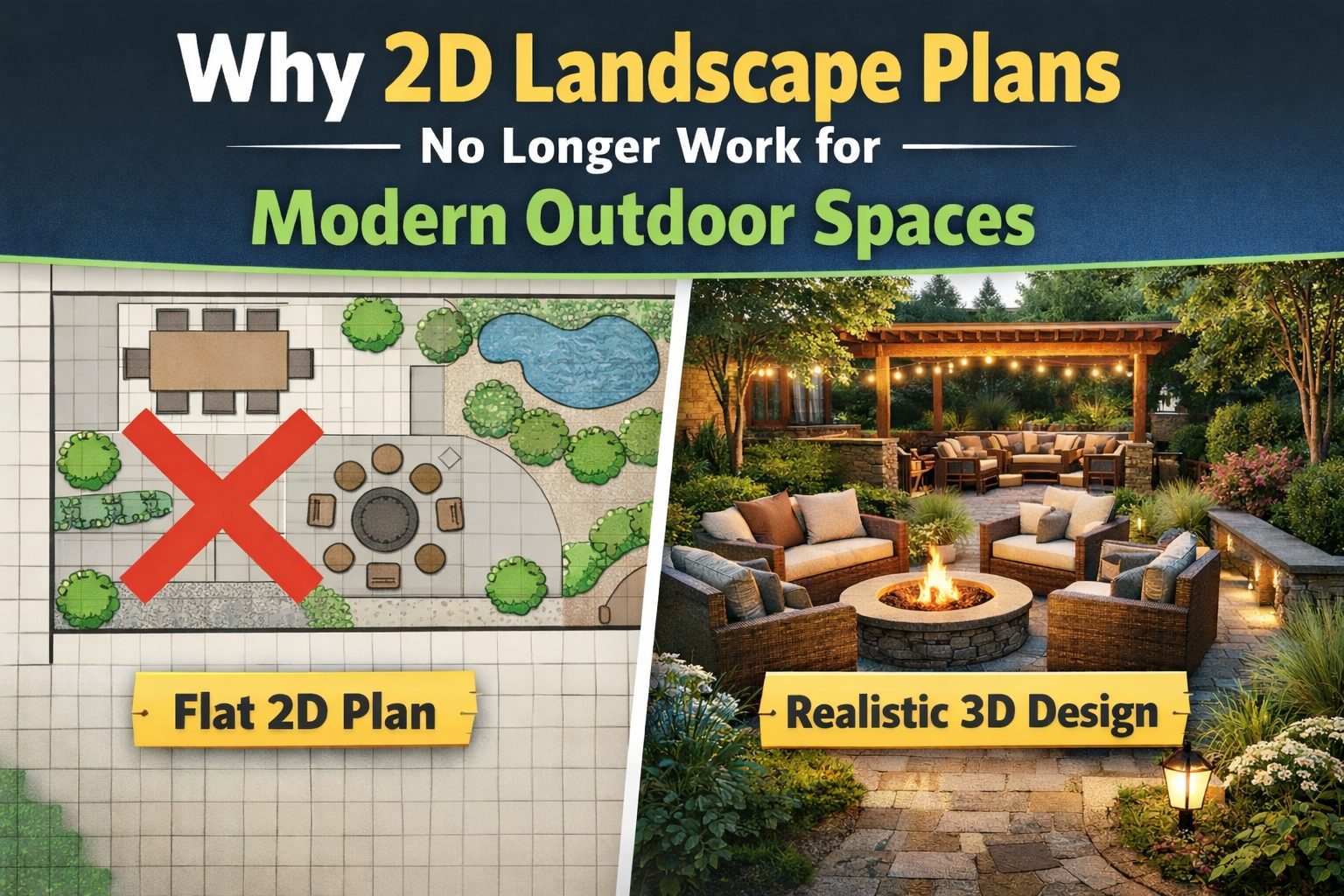
Outdoor spaces have changed. Backyards are no longer “just a lawn with a border.” Today, homeowners build full outdoor living areas with cooking zones, dining and lounge seating, layered planting, lighting, privacy screens, drainage planning, and multiple surface materials that need to look cohesive from every angle. When a project has this many layers, a flat 2D drawing can still be useful for measurements, but it often fails at the most important job: helping you understand what the space will actually feel like once it is built.
The real challenge is that we experience landscapes at eye level, not from a bird’s-eye view. A 2D plan shows where things sit on the ground, but it struggles to communicate height, depth, shadows, sightlines, and how people move through the space in real life. That gap is why many projects that look “perfect on paper” still end up with last-minute changes during installation, budget creep, or a finished yard that feels awkward even if the dimensions were technically correct.
How Modern Outdoor Spaces Outgrew the 2D Plan
A 2D plan was designed for a simpler era of landscaping where the layout mattered more than the lived experience. Modern outdoor spaces are designed like extensions of the home, which means the design must support daily routines, guest flow, privacy, comfort, and atmosphere. When a backyard includes overhead structures, layered lighting, vertical planting, and multiple functional zones, the plan needs to communicate more than just placement.
This is where 2D starts to fall short. It can show a pergola outline, but it cannot easily show how shade will land across the seating area, how the structure will feel from the patio doors, or whether the posts will visually block a view you care about. It can show planting circles, but it rarely shows what those plants look like at maturity, which is where most long-term regret comes from.
What 2D Plans Still Do Well
It is fair to say that 2D plans still have a place. They are helpful for scaling, measuring, defining boundaries, listing materials, and communicating technical placement to contractors. If you are doing a straightforward project, such as a simple patio or a basic planting bed refresh, a 2D plan can be enough to guide execution.
The problem starts when homeowners try to make big decisions, such as zone sizing, feature placement, privacy strategy, and planting massing, using only a top-down diagram. Those decisions are visual and experiential, and that is exactly where 2D becomes risky.
Where 2D Breaks Down for Modern Yards
1) It does not show real-life scale the way people perceive it
A space can be “correct” on paper and still feel wrong in reality. Dining zones look generous in a plan view until you factor in chairs pulling out and people moving around them. Walkways look fine until two people try to walk side by side, or you carry items from the kitchen to the grill area. Fire pit layouts look balanced from above, yet can feel too far for conversation or too close for comfort when you sit down.
2) It hides the impact of height, layering, and elevation
Modern outdoor design depends on vertical elements such as screens, fences, pergolas, raised beds, retaining walls, trees, and layered planting. A 2D plan cannot naturally show how those heights interact, how they shape openness, or how they change the “room feeling” of the yard. This limitation is also why 2D struggles with multi-level projects and complex builds, where depth and vertical structure define the experience.
3) It does not communicate sightlines, which decide whether the space feels premium
Most homeowners care about what they see from key viewpoints: the patio seating, kitchen window, living room, and entry path into the yard. A 2D plan does not clearly show whether a focal feature will feel centered, whether a privacy screen blocks the right angles, or whether the first thing you see is a beautiful layered bed or an awkward utility corner. Sightlines are one of the biggest differences between a “nice yard” and a yard that feels intentionally designed.
4) Planting becomes guesswork instead of a predictable system
Planting decisions are rarely about the plant on day one. They are about the plant in year two and year five. In 2D, plant symbols and labels do not automatically translate into mature size, density, or seasonal behavior. That is why homeowners end up with beds that feel sparse and unfinished, or beds that grow in too aggressively and swallow paths, block views, or create maintenance stress.
5) Materials and lighting look simple on paper but behave differently in real life
Modern landscapes use materials to create mood and structure, and lighting to make the yard functional at night. A 2D plan can list surface types and show lighting icons, but it cannot easily convey glare, warmth, reflectivity, visual “busyness,” or whether the lighting creates comfort versus harsh hotspots. These choices are best validated visually, because the goal is not only accuracy, but a finished look that matches the home.
6) It increases revision risk during construction
When homeowners cannot clearly visualize what they approved, decisions get pushed into the build phase. That is when changes cost the most, because they can trigger re-ordering, extra labor, and delays. The more complex the outdoor space, the more expensive ambiguity becomes.
What Works Better Than 2D: Photo-Based Visual Design and AR Planning
A stronger approach is to design in the context of the real space, using a photo of the yard, and then validate key decisions visually before any money is spent. This is where iScape fits naturally into modern planning workflows. iScape positions itself as a landscape design app that lets you create designs directly on an image of your yard or job site, and it supports both traditional 2D designing and 3D augmented reality designing, so you can see concepts in a more realistic way.
If you are planning with family members or coordinating with a contractor, clarity matters just as much as creativity. iScape also highlights sharing designs and producing professional outputs, which can help keep everyone aligned on the same vision rather than debating a confusing plan view.
From a practical standpoint, the Google Play listing also emphasizes that the app is used to explore ideas before work begins and organize project details in a clear, structured way, which aligns with the real goal: reducing errors and avoiding costly revisions.
Download iScape on the App Store or Google Play Store today and start designing your front yard now!
Share One Clear Plan With Everyone
If revisions keep happening because people imagine the design differently, use a visual design you can share and review together. Create the design in iScape, share it with your partner or contractor, and lock in decisions early so the build phase stays smooth and predictable.
A Simple Modern Workflow That Reduces Mistakes
A modern workflow starts by designing around real constraints, not around a blank page. First, you visualize on a real image of your yard so your design decisions are grounded in actual proportions and context. Next, you build zones that reflect how you live, such as cooking, dining, lounging, play, and garden areas, and you check the flow between them so movement feels natural. After that, you validate sightlines from the places you care about most, such as indoor views and primary seating, and you refine feature placement until the space feels intentional. Finally, you confirm planting layers and material combinations visually, because that is where most aesthetic regret comes from when people rely only on 2D.
This process is not about adding complexity. It is about making decisions once, confidently, and reducing the kind of uncertainty that causes mid-project changes.
Conclusion
2D landscape plans are not “bad,” but they are no longer enough for modern outdoor spaces that depend on comfort, function, layering, and strong visual composition. The more your yard includes vertical elements, multi-zone living, planting maturity planning, and lighting, the more you benefit from photo-based visualization and AR-style previews that help you see what you are approving. When you plan visually first, you reduce confusion, cut revisions, and increase the chance that the finished outdoor space looks and feels exactly the way you imagined.
Visualize Your Yard Before You Build
If you are still approving outdoor designs from a flat sketch, switch to a visual mockup first so you can confirm scale, sightlines, and layout flow in a realistic way. Download iScape, upload a photo of your yard, and start testing your ideas in 2D or 3D augmented reality before you spend on materials or labor.
Download iScape on the App Store or Google Play Store today and start designing your front yard now!
FAQs
1) Are 2D landscape plans completely useless now?
No. They’re still helpful for measurements, permits, and installer reference. But they’re not enough for visual decision-making.
2) What’s the biggest risk of relying only on 2D plans?
Scale mistakes. Things can be “technically correct” and still feel wrong once built.
3) What’s better than 2D for homeowners?
A visual plan that shows how the space looks from real viewpoints, with height, layering, and materials.
4) Will visual planning reduce project cost?
It often reduces expensive revisions, change orders, and rework, which is where budgets typically blow up.
5) Can I still work with a contractor if I use visual planning?
Yes. A clearer plan improves communication and helps contractors build faster with fewer changes.