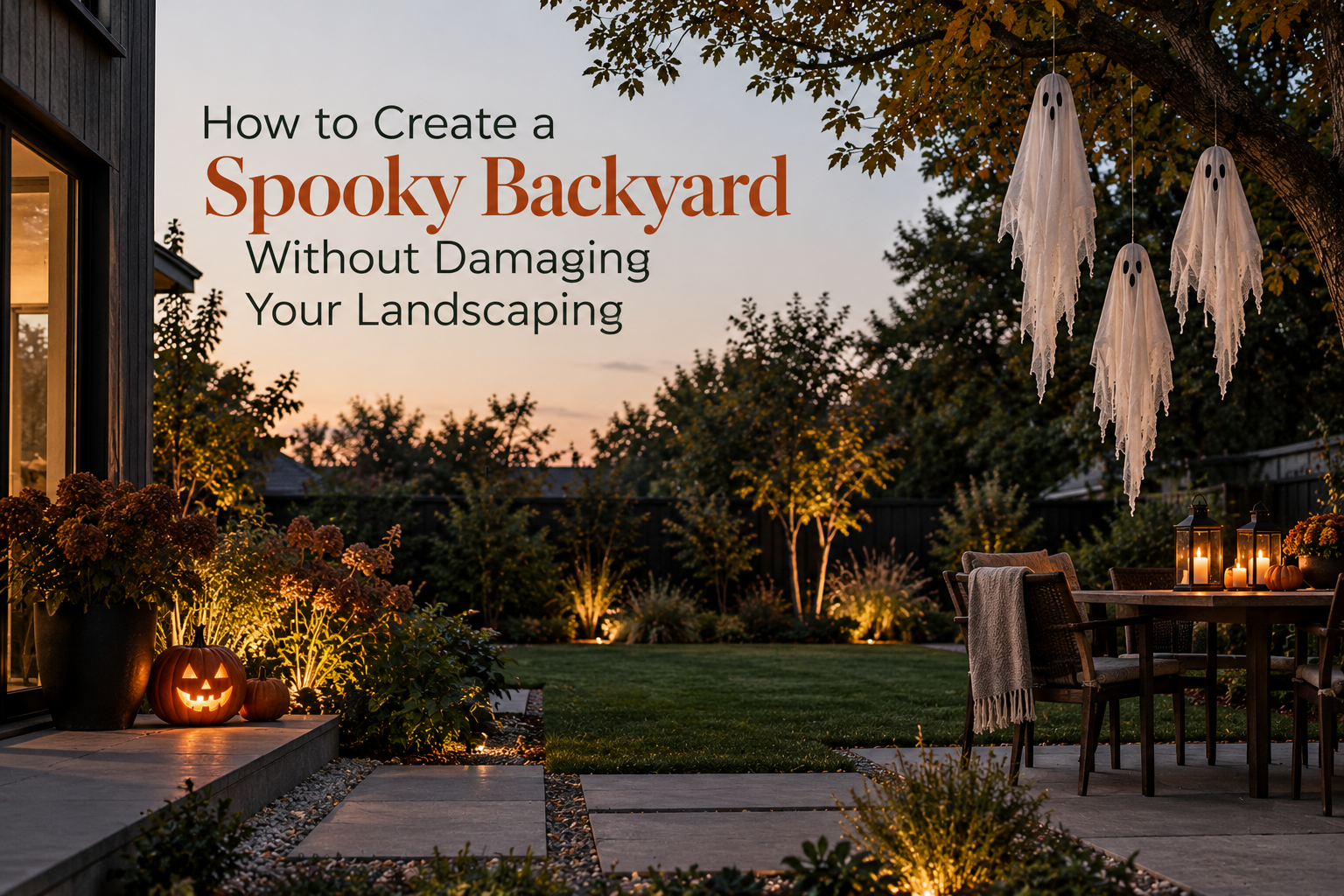
The best Halloween yards look completely transformed after dark and completely normal again once the decorations come down. That second part is easy to overlook.
Oversized skeletons, artificial spider webs, fog machines, pathway lights, inflatables, extension cords, and hanging decorations can create an incredible Halloween atmosphere. But they can also flatten grass, snap branches, puncture irrigation lines, block sprinklers, compact soil, and turn pathways into tripping hazards when they are added without considering the landscape underneath. You do not have to choose between a memorable Halloween setup and a healthy yard. With a little planning, your existing trees, plants, paths, lawn, and outdoor lighting can actually do much of the work for you. Here is how to create a spooky backyard that makes an impact for Halloween without creating landscaping problems that last into November.
Start With Your Yard, Not the Decorations
Before buying another skeleton or inflatable, walk through your backyard during the day and identify what is already there. Look for:
- Main walkways and entrances
- Patio and deck areas
- Lawn
- Mature trees
- Shrubs and planting beds
- Steps and changes in elevation
- Fences and walls
- Pergolas or other structures
- Outdoor electrical outlets
- Irrigation heads
- Existing landscape lighting
Then decide which two or three areas should become the focus of your Halloween setup. You might create a graveyard scene beside a walkway, turn a mature tree into the visual centerpiece, or transform the patio into a Halloween gathering area. Trying to decorate every square foot often creates clutter and increases the amount of equipment sitting on plants and lawn. A yard with clearly defined areas is also easier for guests to move through. If your landscape already feels difficult to navigate, these common landscape design mistakes are worth addressing before adding temporary décor.
Build the Halloween Display Around a Focal Point
Instead of spreading small decorations everywhere, create one memorable scene. It could be:
- A large skeleton beneath a tree
- A small haunted graveyard
- A fog-covered seating area
- A dramatic illuminated tree
- A spooky garden entrance
- A Halloween dining setup
- A shadow projection against a fence or wall
Once the focal point is established, use smaller details to guide people toward it. This works better visually and reduces the number of stakes, wires, props, and decorations interacting with the landscape. Your plants, lawn, trees, and hardscape should still remain visible enough to give the display structure.
Use Lighting to Create the Spookiness
You can often make a backyard feel dramatically different without adding many physical decorations at all. Lighting can transform ordinary landscape features into Halloween elements. Try lighting a mature tree from below so its branches create exaggerated shadows. Position a light behind ornamental grasses so their movement becomes visible after dark. Use a projection against a fence, wall, or garage rather than hanging decorations throughout nearby plants. You could also illuminate:
- Tree trunks
- Large shrubs
- Garden sculptures
- Path edges
- Walls
- Gates
- Pergolas
- Architectural features
The trick is contrast. Do not illuminate the entire backyard evenly. Areas of darkness between selected focal points create more atmosphere than flooding the whole landscape with bright light.
If you already have or plan to install permanent outdoor lighting, read iScape’s guide on how to plan landscape lighting before plants and hardscape go in.
Protect Your Lawn From Heavy Halloween Props
Large decorations can stay in place for several weeks, which can be hard on turf. Inflatables, tables, heavy tombstones, speakers, large displays, and temporary furniture can flatten grass and reduce the sunlight and airflow reaching it. Whenever possible, put heavier decorations on:
- Patios
- Decks
- Gravel
- Paved walkways
- Mulched display areas
If something needs to sit on the lawn, avoid leaving it in exactly the same position for an extended period. Moving lightweight decorations occasionally can reduce prolonged pressure on one area. Avoid covering grass with plastic sheets or impermeable materials for days at a time. While they may create the visual effect you want, they can trap moisture and block light.
Think Before You Push Stakes Into the Ground
Halloween decorations often come with stakes. Path lights, signs, inflatables, ghosts, tombstones, and oversized characters may all need to be anchored. But you may have more beneath your lawn than soil. Depending on your property, shallow underground areas may contain:
- Irrigation tubing
- Drip lines
- Landscape lighting cables
- Drainage components
- Other buried utilities
Identify your irrigation and landscape-lighting layout before using long stakes. For lightweight decorations, consider alternatives such as weighted bases, gravel-filled planters or sandbags when appropriate. Fewer stakes also make post-Halloween cleanup much easier.
Do Not Nail Halloween Decorations Into Trees
Mature trees make some of the best Halloween props because they already provide height, shadows, texture, and dramatic branching. Use them carefully. Avoid putting nails, staples, screws, or hooks directly into trunks or branches just to secure temporary decorations. Instead, lightweight decorations can often be attached with soft, removable materials that do not cut into the bark. Whatever you use should remain loose enough that it does not constrict the tree, and it should be removed promptly once Halloween is over. Thin wire and tightly pulled fishing line are especially easy to overlook during cleanup.
Keep Heavy Decorations Off Small Branches
A lightweight hanging ghost may be fine on a strong branch. A large lantern or heavy skeleton may not be. Before hanging anything, consider both the weight of the decoration and how it will behave in the wind. Avoid hanging substantial objects from:
- Newly planted trees
- Young ornamental trees
- Thin branches
- Damaged limbs
- Branches already carrying significant weight
Do not bend or pull a branch into position simply to improve the appearance of a decoration. The Halloween display should adapt to the tree, not the other way around.
Be Careful With Artificial Spider Webs
Stretchable artificial spider webbing creates an instant Halloween effect, but covering entire shrubs and planting beds with it can make cleanup difficult. The material can become wrapped around leaves, branches, seed heads, flowers, and dense foliage. Instead of covering plants heavily, concentrate webbing on structures such as:
- Railings
- Pergolas
- Fences
- Posts
- Gates
- Freestanding props
If you use it on shrubs, apply it lightly and remove it carefully rather than pulling it through the plant. Lighting projections can also create web effects without physically covering vegetation.
Let Existing Plants Become Halloween Decorations
A spooky landscape does not require hiding the landscape. Your existing plants can create some of the best Halloween atmosphere. Tall ornamental grasses move naturally in the wind. Dense evergreen shrubs create dark backgrounds. Bare branches form dramatic silhouettes. Groundcovers can make a graveyard scene feel more integrated into the yard. Look at each plant for its:
- Shape
- Texture
- Movement
- Shadow
- Height
- Seasonal appearance
Then use lighting and a few props to exaggerate those characteristics. This usually looks more intentional than covering every plant with artificial decorations.
Keep Lights From Smothering Plants
LED lighting generally produces less heat than traditional incandescent decorative lighting, but you should still avoid tightly wrapping delicate plants. Do not pull light strands tightly around:
- Shrub branches
- Tree trunks
- Small trees
- Delicate stems
Leave some room around growing material and avoid burying lights deep inside plants. Temporary lighting should also be removed once the season is finished rather than being left around trunks and branches indefinitely.
Keep Electrical Equipment Away From Wet Planting Areas
Halloween displays can quickly become cable-heavy. You might have:
- Projectors
- Fog machines
- String lights
- Inflatables
- Speakers
- Spotlights
- Animated decorations
Use outdoor-rated equipment and keep electrical connections appropriately protected from moisture. Whenever possible, route cables along hardscape rather than through planting beds. Do not hide extension cords underneath piles of leaves or mulch, and avoid running loose cords across walkways. If a cable has to cross a traffic route, use an appropriate outdoor cable protector so guests can see and safely cross it.
Check Where Your Sprinklers Are
Few things ruin a Halloween setup faster than discovering that a sprinkler head sits directly underneath an inflatable. Before placing large props, run your irrigation system and note where sprinklers appear and which areas they cover. Avoid putting large decorations directly over sprinkler heads. Doing so can:
- Prevent the sprinkler from operating correctly
- Redirect water unexpectedly
- Soak electrical decorations
- Leave surrounding plants without normal coverage
If your Halloween installation will remain up for several weeks, make sure temporary decorations have not unintentionally changed how your yard is being watered. Thinking about irrigation, planting, lighting, movement, and hardscape together is part of creating a functional landscape.
Use Fog Machines Strategically
Fog can create atmosphere faster than almost any physical decoration. You do not need to bury the machine inside a planting bed to make fog move through the landscape. Place the unit on an appropriate stable surface and direct the effect toward the scene you want to create. Keep the equipment itself away from dry leaves, mulch, ornamental grasses, and other potentially combustible materials, and follow the manufacturer's instructions for outdoor use. Fog works particularly well around a focal point, pathway entrance, patio edge, or graveyard display. A little goes a long way.
Protect Planting Beds From Foot Traffic
During a Halloween party, your guests may pose a greater risk to the garden than the decorations. People naturally take the shortest route when they cannot clearly see where they are supposed to walk. Use lighting and décor to make the intended path obvious. You can line routes with:
- Pumpkins
- Low lights
- Lanterns
- Small tombstones
- Decorative markers
The objective is not to create a barrier. It is to subtly communicate where people should move. This keeps guests away from delicate planting beds and reduces soil compaction around plants.
Never Hide Steps or Level Changes
Halloween is supposed to be dark. Your pathways should not be. Steps, patio transitions and sudden changes in elevation need to remain easy to identify. Avoid placing large props directly beside a change in level where they could obscure it. Likewise, pumpkins and decorations should sit beside walkways rather than partly on them.
A Halloween path should feel eerie without being difficult to navigate. When designing the route itself, think about how paths guide movement through the yard. The principles in how to use curves to create better flow in your landscape can also help when deciding how people should move between outdoor areas.
Create a Halloween Gathering Area on the Patio
If you are hosting friends or family, concentrating activity around an existing patio can protect the rest of the landscape. Instead of spreading seating throughout the lawn, use the patio as the main social zone. You can create atmosphere with:
- Dark table linens
- Battery-powered lanterns
- Pumpkins
- Candles or safe candle alternatives
- Hanging decorations
- Projection lighting
- Halloween-themed cushions
- Small tabletop décor
Keep enough room around tables and furniture for comfortable movement. If your patio already feels cramped once furniture is added, the problem may be the underlying layout rather than your Halloween setup. See how to create a patio that fits your outdoor space better for more planning guidance.
Protect Newly Planted Areas
Recently installed trees, shrubs, perennials, and groundcovers deserve extra protection. They are still establishing root systems and may be more vulnerable to physical disturbance.
Avoid putting heavy props, stakes, temporary seating, cables, or frequently used pathways around newly planted areas. Instead, let the planting form the background and anchor decorations to nearby hardscape or freestanding supports.
Plan for Wind Before Halloween Night
A lightweight ghost looks harmless until a strong gust repeatedly throws it against a shrub. Make sure hanging and freestanding decorations have enough clearance from plants. Pay particular attention to:
- Inflatables
- Fabric ghosts
- Banners
- Hanging skeletons
- Lightweight tombstones
- Large artificial spider webs
If your yard is particularly exposed, check decorations regularly and bring vulnerable items in when severe weather is expected.
Watch Pumpkins as the Season Progresses
Pumpkins are landscape-friendly because they are freestanding and require no stakes or attachment. But they eventually decompose. Do not leave soft or rotting pumpkins pressed against plant stems, timber, deck boards, or porous hardscape.
For longer displays, putting pumpkins on a small base or tray can make cleanup easier and reduce staining. Check them regularly, especially after warm or wet weather.
Design for Easy November Cleanup
Before installing any decoration, ask one useful question:
How difficult will this be to remove?
Consider whether the decoration:
- Uses adhesive
- Requires deep stakes
- Will become tangled in plants
- Leaves small pieces behind
- Needs extensive wiring
- Blocks irrigation
- Traps leaves or moisture
- Will damage grass after several weeks
Decorations that rely on lighting, freestanding elements, existing structures, and hardscape are generally easier to remove than elaborate installations woven throughout plants.
Halloween should leave memories behind, not plastic webbing tangled in the shrubs until spring.
A Simple Formula for a Better Halloween Backyard
If you are not sure where to start, use this structure:
- Choose one focal point: Create the main Halloween moment around a tree, patio, wall, garden structure, or graveyard-style display.
- Define the route: Use low-level lighting and small decorations to guide guests safely toward it.
- Add atmospheric lighting: Use shadows, silhouettes, uplighting, and selective illumination rather than lighting everything.
- Let the landscape contribute: Use trees, shrubs, grasses, and existing garden features instead of covering them.
- Keep the gathering zone on hardscape: Whenever possible, put seating, food, speakers, and heavier equipment on your patio or deck.
- Keep the rest restrained: A few carefully chosen details usually look better than filling every available space.
Visualize the Setup Before You Decorate
One reason Halloween displays become cluttered is that decorations are often purchased individually without considering what the finished yard will look like.
Planning the whole scene first can help. With iScape, you can visualize the broader outdoor layout and understand how focal points, pathways, planting beds, patios, trees, and gathering areas relate to one another before you start moving things around.
You might discover that one strong display beside a tree creates more impact than decorations scattered across the entire lawn.
Or you may realize that a planned prop blocks an important walkway or makes the patio feel overcrowded. Seeing the space as a complete composition makes it easier to know where to add something and, just as importantly, where to stop.
Final Takeaway
A great Halloween backyard should feel dramatically different for a few nights without permanently changing the landscape underneath it. Use lighting and shadows before adding more props. Put heavy decorations on the landscape whenever possible. Keep stakes away from irrigation and underground systems. Protect young plants. Avoid damaging trees. Keep walkways obvious and level changes visible.
Most importantly, use the landscape you already have. A mature tree, moving ornamental grass, winding path, dense shrub, or dark garden corner can create more Halloween atmosphere than another cart full of decorations. Plan carefully, decorate selectively, and you can have a backyard that looks perfectly spooky in October and perfectly healthy once November arrives.
Download iScape on the App Store or Google Play Store today and start designing today. Try a free trial today at iScape!
FAQs
Can Halloween decorations damage grass?
Yes. Heavy decorations, inflatables, furniture, and materials that cover the lawn for long periods can flatten grass and restrict light and airflow. Place larger items on hardscape where possible and avoid leaving heavy objects in one lawn location for several weeks.
Is it safe to hang Halloween decorations from trees?
Lightweight decorations can be used carefully, but avoid nails, staples, screws, tight wires, or heavy items on small branches. Use removable attachments and remove everything after Halloween.
How can I make my backyard spooky without using lots of decorations?
Focus on lighting, shadows, silhouettes, fog, one strong focal point, and the shapes of existing plants and trees. A few well-planned elements can create more atmosphere than dozens of unrelated props.
Where should I place Halloween decorations in the backyard?
Start with patios, hardscape, fences, walls, mature trees, and areas beside pathways. Keep decorations away from irrigation heads, young plants, narrow walking routes, and level changes.
How do I protect plants during a Halloween party?
Keep foot traffic on established paths and hardscape, make routes visible with lighting, avoid attaching heavy decorations to plants, and keep seating and entertainment areas away from delicate planting beds.
.png)